One of the most shocking things for every salaried employee in India is seeing the “TDS” deduction on their monthly pay slip. Some months it can be zero. Some months it can be proof rupees. And, every year, millions of employees end up paying more TDS than they should have – and end up with an unexpected tax bill if their employer has deducted too little.
TDS on salary is not complicated once you understand it. What is TDS on salary and how it will be calculated step by step in both tax regimes for the financial year 2026-27 What does the new Income Tax Act 2025 mean for you? Read here to understand how to legally deduct your monthly TDS without breaking any law.
Quick Summary: TDS on Salary FY 2026-27
| Factor | Detail |
|---|---|
| Governing Section | Section 392, Income Tax Act 2025 (formerly Section 192, IT Act 1961) |
| Applicable From | April 1, 2026 (new Act) |
| Who Deducts | Employer — acts as TDS deductor |
| When Deducted | Every month from salary |
| Default Tax Regime | New Tax Regime (employee must opt out via Form 122 for Old Regime) |
| New Regime Standard Deduction | ₹75,000 |
| Old Regime Standard Deduction | ₹50,000 |
| Zero Tax Limit (New Regime) | Up to ₹12,00,000 taxable income (Section 87A rebate) |
| Effective Zero-TDS Salary | Up to ₹12,75,000 gross annual salary |
| TDS Deposit Deadline | 7th of following month (30 April for March deductions) |
| Form 16 (now called) | Form 130 (from Tax Year 2026-27) |
| Quarterly TDS Return | Form 24Q (now Form 138) |
Important 2026 update: The Income Tax Act 1961 has been replaced by the Income Tax Act 2025, effective April 1, 2026. TDS on salary now falls under Section 392 of the new Act (previously Section 192). The calculation method and slab rates are unchanged — only the legal reference has shifted. Salary paid up to March 31, 2026 still falls under the old Act (Section 192).
What is TDS on Salary?
TDS (Tax Deducted at Source) on salary is the income tax that your employer deducts from your monthly salary and deposits directly with the Income Tax Department on your behalf.
Instead of paying your entire annual income tax bill in one lump sum at year-end, the government collects it in 12 monthly instalments through your employer. Your employer acts as the tax deductor — legally obligated to estimate your annual tax liability, divide it by 12, and deduct that amount from each monthly salary.
Why TDS exists:
- Ensures regular cash flow to the government throughout the year
- Prevents tax evasion by collecting at source before money reaches the employee
- Reduces the burden of a large one-time tax payment for employees
- Creates an automatic audit trail of income and tax paid
TDS on Salary — 6-Step Calculation Method
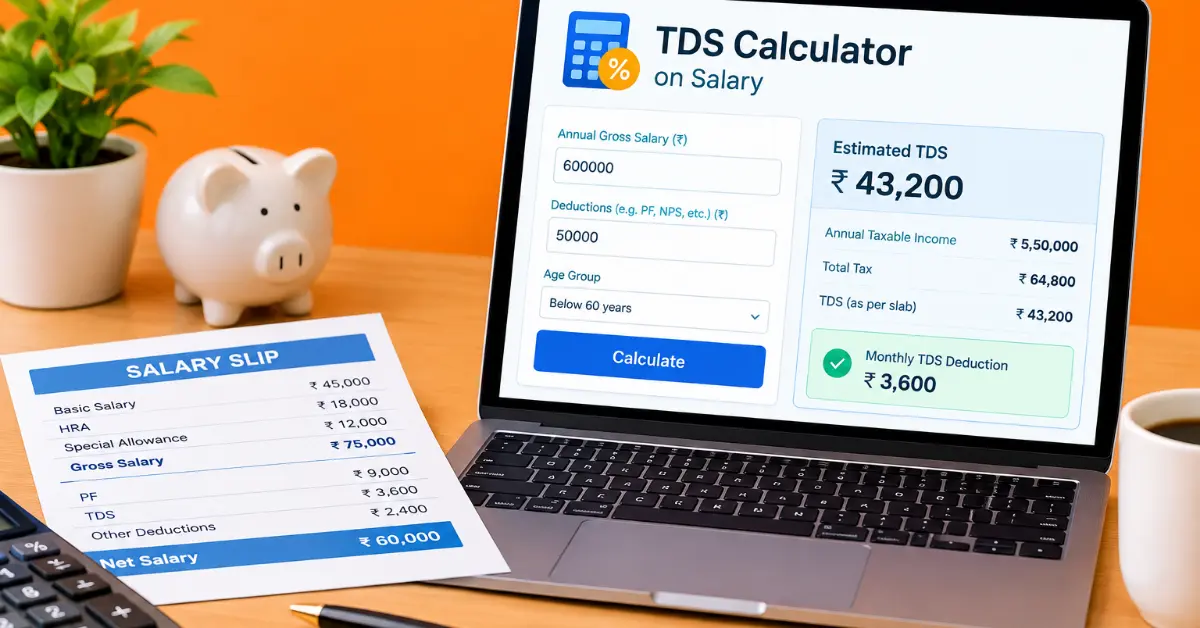
TDS on Salary Calculator
Estimate annual tax and monthly TDS under the New and Old Tax Regimes.
This is the exact method your employer’s payroll team uses to calculate your monthly TDS. Understanding it puts you in control of your own tax planning.
Step 1 — Estimate Annual Gross Salary
Add up all taxable salary components for the full financial year:
| Component | Taxability |
|---|---|
| Basic Salary | 100% taxable |
| Dearness Allowance | 100% taxable |
| HRA | Partially exempt (Old Regime only) |
| Special Allowance | 100% taxable |
| Transport Allowance | Covered by standard deduction |
| Medical Allowance | Covered by standard deduction |
| Bonus / Variable Pay | 100% taxable in month received |
| LTA | Exempt (Old Regime with proof only) |
Example: Employee with ₹12 LPA CTC → Annual Gross Salary approximately ₹11,50,000 (after removing Employer EPF and Gratuity which are not salary income).
Step 2 — Deduct Standard Deduction
| Regime | Standard Deduction |
|---|---|
| New Tax Regime (default) | ₹75,000 |
| Old Tax Regime | ₹50,000 |
Example (New Regime): ₹11,50,000 − ₹75,000 = ₹10,75,000 taxable income
Step 3 — Deduct Other Exemptions and Deductions (Old Regime Only)
Under the Old Tax Regime, additional deductions reduce taxable income:
| Deduction | Maximum Amount |
|---|---|
| Section 80C (EPF, PPF, ELSS, LIC, home loan principal) | ₹1,50,000 |
| Section 80D (health insurance premium) | ₹25,000 (₹50,000 for senior citizens) |
| Section 80CCD(1B) (NPS additional contribution) | ₹50,000 |
| HRA Exemption (Section 10(13A)) | Calculated separately |
| Home loan interest (Section 24b) | Up to ₹2,00,000 |
HRA exemption is the lowest of:
- Actual HRA received
- Rent paid minus 10% of Basic + DA
- 50% of Basic + DA (metro cities) or 40% (non-metro cities)
None of these deductions are available under the New Tax Regime — except the employer’s NPS contribution under Section 80CCD(2), which is available under both regimes.
Step 4 — Apply Tax Slabs
New Tax Regime Slabs (FY 2026-27) — Default:
| Annual Taxable Income | Tax Rate |
|---|---|
| Up to ₹4,00,000 | 0% |
| ₹4,00,001 – ₹8,00,000 | 5% |
| ₹8,00,001 – ₹12,00,000 | 10% |
| ₹12,00,001 – ₹16,00,000 | 15% |
| ₹16,00,001 – ₹20,00,000 | 20% |
| ₹20,00,001 – ₹24,00,000 | 25% |
| Above ₹24,00,000 | 30% |
Old Tax Regime Slabs (FY 2026-27) — Must opt in:
| Annual Taxable Income | Tax Rate |
|---|---|
| Up to ₹2,50,000 | 0% |
| ₹2,50,001 – ₹5,00,000 | 5% |
| ₹5,00,001 – ₹10,00,000 | 20% |
| Above ₹10,00,000 | 30% |
Step 5 — Add Surcharge (if applicable) and 4% Cess
Surcharge on income tax:
| Annual Income | Surcharge Rate |
|---|---|
| Below ₹50,00,000 | 0% |
| ₹50,00,001 – ₹1,00,00,000 | 10% |
| ₹1,00,00,001 – ₹2,00,00,000 | 15% |
| ₹2,00,00,001 – ₹5,00,00,000 | 25% |
| Above ₹5,00,00,000 | 37% (25% under New Regime) |
Health and Education Cess: 4% of (tax + surcharge) — applies under both regimes.
Step 6 — Apply Section 87A Rebate and Divide by 12
Section 87A Rebate (New Regime): If net taxable income is ₹12,00,000 or below, the Section 87A rebate completely cancels the tax liability — making effective tax zero up to ₹12 lakh taxable income.
Monthly TDS = Annual Tax ÷ 12
For mid-year joiners: Annual Tax ÷ Remaining Months in Financial Year
Worked Examples: TDS Calculation FY 2026-27
Example 1 — ₹8 LPA Gross Salary (New Tax Regime)
| Step | Calculation | Amount |
|---|---|---|
| Annual Gross Salary | Given | ₹8,00,000 |
| Less: Employer EPF + Gratuity | Not salary income | −₹31,215 |
| Annual Salary Income | ₹7,68,785 | |
| Less: Standard Deduction | New Regime | −₹75,000 |
| Taxable Income | ₹6,93,785 | |
| Tax on ₹4,00,000 @ 0% | ₹0 | |
| Tax on ₹2,93,785 @ 5% | (₹4L to ₹6.93L) | ₹14,689 |
| Total Tax before rebate | ₹14,689 | |
| Section 87A Rebate | Taxable income < ₹12L | −₹14,689 |
| Net Annual Tax | ₹0 | |
| Monthly TDS | ₹0 |
Result: Zero TDS at ₹8 LPA under the New Tax Regime.
Example 2 — ₹15 LPA Gross Salary (New Tax Regime)
| Step | Calculation | Amount |
|---|---|---|
| Annual Gross Salary | Given | ₹15,00,000 |
| Less: Employer EPF + Gratuity | −₹31,215 | |
| Annual Salary Income | ₹14,68,785 | |
| Less: Standard Deduction | New Regime | −₹75,000 |
| Taxable Income | ₹13,93,785 | |
| Tax on ₹4,00,000 @ 0% | ₹0 | |
| Tax on ₹4,00,000 @ 5% | (₹4L to ₹8L) | ₹20,000 |
| Tax on ₹4,00,000 @ 10% | (₹8L to ₹12L) | ₹40,000 |
| Tax on ₹1,93,785 @ 15% | (₹12L to ₹13.94L) | ₹29,068 |
| Tax before cess | ₹89,068 | |
| Section 87A Rebate | Taxable income > ₹12L | ₹0 (not applicable) |
| Add: 4% Health & Education Cess | 4% of ₹89,068 | ₹3,563 |
| Net Annual Tax | ₹92,631 | |
| Monthly TDS | ₹7,719/month |
Example 3 — ₹15 LPA Gross Salary (Old Tax Regime, with deductions)
| Step | Calculation | Amount |
|---|---|---|
| Annual Salary Income | ₹14,68,785 | |
| Less: Standard Deduction | Old Regime | −₹50,000 |
| Less: HRA Exemption | Paying ₹20,000/month rent in metro | −₹67,800 |
| Less: 80C (PF + PPF + LIC) | Maximum | −₹1,50,000 |
| Less: 80D (Health Insurance) | −₹25,000 | |
| Taxable Income | ₹12,75,985 | |
| Tax on ₹2,50,000 @ 0% | ₹0 | |
| Tax on ₹2,50,000 @ 5% | ₹12,500 | |
| Tax on ₹5,00,000 @ 20% | ₹1,00,000 | |
| Tax on ₹2,75,985 @ 30% | ₹82,796 | |
| Tax before cess | ₹1,95,296 | |
| Add: 4% Cess | ₹7,812 | |
| Net Annual Tax | ₹2,03,108 | |
| Monthly TDS | ₹16,926/month |
Comparison at ₹15 LPA: New Regime: ₹7,719/month TDS — Old Regime with max deductions: ₹16,926/month TDS. New Regime wins at ₹15 LPA even with significant deductions.
Example 4 — ₹25 LPA (New Tax Regime)
| Step | Amount |
|---|---|
| Annual Salary Income | ₹24,18,785 |
| Less: Standard Deduction | −₹75,000 |
| Taxable Income | ₹23,43,785 |
| Tax on ₹4L @ 0% | ₹0 |
| Tax on ₹4L @ 5% | ₹20,000 |
| Tax on ₹4L @ 10% | ₹40,000 |
| Tax on ₹4L @ 15% | ₹60,000 |
| Tax on ₹4L @ 20% | ₹80,000 |
| Tax on ₹3.43L @ 25% | ₹85,750 |
| Tax before cess | ₹2,85,750 |
| 4% Cess | ₹11,430 |
| Annual Tax | ₹2,97,180 |
| Monthly TDS | ₹24,765/month |
TDS on Salary — Quick Reference Table (New Tax Regime, FY 2026-27)
| Annual CTC | Annual Taxable Income (approx.) | Annual Tax | Monthly TDS |
|---|---|---|---|
| ₹5 LPA | ₹3,69,000 | ₹0 | ₹0 |
| ₹6 LPA | ₹4,69,000 | ₹0 | ₹0 |
| ₹8 LPA | ₹6,93,785 | ₹0 | ₹0 |
| ₹10 LPA | ₹8,93,785 | ₹0 | ₹0 |
| ₹12 LPA | ₹10,93,785 | ₹0 | ₹0 |
| ₹13 LPA | ₹11,93,785 | ₹0 | ₹0 |
| ₹14 LPA | ₹12,43,785 | ₹24,570 | ₹2,048 |
| ₹15 LPA | ₹13,93,785 | ₹92,631 | ₹7,719 |
| ₹18 LPA | ₹16,93,785 | ₹1,82,139 | ₹15,178 |
| ₹20 LPA | ₹18,93,785 | ₹2,42,239 | ₹20,187 |
| ₹25 LPA | ₹23,43,785 | ₹2,97,180 | ₹24,765 |
| ₹30 LPA | ₹28,43,785 | ₹4,21,980 | ₹35,165 |
| ₹50 LPA | ₹47,93,785 | ₹10,15,380 | ₹84,615 |
All figures assume 50% Basic structure, EPF capped at ₹1,800/month, no surcharge below ₹50 LPA.
New Tax Regime vs Old Tax Regime — TDS Comparison
| Annual CTC | Monthly TDS (New Regime) | Monthly TDS (Old Regime, max deductions) | Better Choice |
|---|---|---|---|
| ₹8 LPA | ₹0 | ₹0 | New Regime (simpler) |
| ₹12 LPA | ₹0 | ₹0 | New Regime (simpler) |
| ₹15 LPA | ₹7,719 | ₹16,926 | New Regime |
| ₹20 LPA | ₹20,187 | ₹24,500* | New Regime |
| ₹25 LPA | ₹24,765 | ₹22,000* | Old Regime |
| ₹30 LPA | ₹35,165 | ₹28,500* | Old Regime |
*Old Regime figures assume full ₹1.5L 80C, ₹25,000 80D, ₹20,000/month HRA exemption, home loan interest ₹2L.
The crossover point where Old Regime starts producing lower TDS is approximately ₹22–25 LPA — and only for employees with significant deductions (home loan, maximum 80C, high HRA exemption).
How to Declare Your Tax Regime to Your Employer
From FY 2026-27 under the Income Tax Act 2025:
- New Regime is the default — no action needed
- To opt for Old Regime: Submit Form 122 to your employer at the start of the financial year (April or when you join)
- Employees can switch regime at the time of filing their ITR — but the regime chosen with the employer for TDS purposes is separate from the regime chosen at ITR filing
- Once you submit Form 122 for Old Regime, your employer will ask for Form 12BB — the investment declaration form where you declare HRA, 80C, 80D, home loan interest etc.
Form 12BB — Investment Declaration (Old Regime)
Form 12BB is the declaration you submit to your employer in April (beginning of FY) declaring:
| Declaration | Details |
|---|---|
| HRA Exemption | Landlord’s name, address, PAN (if annual rent > ₹1 lakh), monthly rent amount |
| LTA Claim | Travel details for leave travel concession |
| 80C Investments | EPF, PPF, ELSS, LIC, home loan principal — with proof |
| 80D Health Insurance | Premium receipt |
| Home Loan Interest | Banker’s certificate of interest paid |
| Other deductions | As applicable |
Submitting Form 12BB early (April) ensures your TDS is reduced from the first month of the year. Submitting late (December or January) means your employer has to recover the full year’s shortfall in 2-3 months — causing a TDS spike in those months.
Key Changes Under Income Tax Act 2025 (From April 2026)
| Old Reference | New Reference | What Changed |
|---|---|---|
| Section 192 | Section 392 | TDS on salary — same rules, new number |
| Section 193, 194 etc. | Section 393 | TDS on non-salary — new section |
| Form 16 | Form 130 | Salary TDS certificate — new form number |
| Form 24Q | Form 138 | Quarterly TDS return — new form number |
| Form 12BB | Form 122 | Employee regime declaration — new form number |
| Section 206AB | Omitted | Removed from April 1, 2025 — no longer applies to salary |
The practical impact for employees is minimal — the tax slabs, rates, deductions, and calculation method are all unchanged. Only the legal section numbers and form names have been updated. If your employer sends you new form names, this table explains what they correspond to under the old system.
Why Your TDS May Change Mid-Year
Many employees notice their TDS amount changes in October-November or January-February. This happens for several reasons:
Reason 1 — You submitted investment proofs late. If you declared investments in April but submitted actual proofs only in December, your employer recalculates tax based on confirmed amounts and adjusts remaining monthly deductions.
Reason 2 — You received a salary hike. A mid-year increment increases your projected annual income, raising the tax liability. Your employer recalculates and spreads the revised tax across remaining months.
Reason 3 — You received a bonus. Bonuses are treated as salary income in the month received. They increase your annual taxable income and trigger a TDS recalculation.
Reason 4 — You switched jobs. Your new employer calculates TDS on only the salary you earn with them. You must submit Form 12B or your previous Form 130 (Form 16) so they factor in income already earned that year — otherwise you may under-pay TDS and face a self-assessment demand.
Reason 5 — You forgot to declare your tax regime. If you do not submit Form 122 to opt for the Old Regime, your employer defaults to the New Regime — which may produce different TDS than you expected.
How to Reduce Your Monthly TDS Legally
Option 1 — Optimise salary structure (most effective below ₹25 LPA). If your employer allows flexible benefit plans, maximise tax-efficient components:
- Meal allowance: ₹200/meal is tax-free (both regimes from April 2026)
- NPS employer contribution under 80CCD(2): tax-free under both regimes, up to 10% of Basic + DA (14% for government employees)
Option 2 — Opt for Old Regime with maximum deductions (best above ₹25 LPA). If you have a home loan, pay significant rent, and make full 80C investments — calculate whether Old Regime saves more tax than New Regime. Submit Form 122 in April.
Option 3 — Submit Form 12BB early and accurately. Declare all your investments in April, not December. Early declaration distributes the tax benefit across all 12 months, keeping each month’s TDS lower.
Option 4 — Employer NPS contribution. Ask your employer to structure part of your CTC as NPS contribution under 80CCD(2). Up to 10% of Basic + DA contributed by the employer is fully deductible from taxable income under both regimes — potentially saving ₹3,000 to ₹8,000/month in TDS for higher-salary employees.
Option 5 — Claim TDS refund if over-deducted. If your employer deducted more TDS than your actual tax liability (common when investment proofs are submitted after year-end), file ITR and claim the refund. Refunds are typically processed within 30 to 60 days of ITR filing.
What Happens if Employer Does Not Deduct TDS?
If your employer fails to deduct TDS, the liability shifts to both parties:
| Consequence | Details |
|---|---|
| For Employee | Liable to pay advance tax by March 15 or self-assessment tax by July 31 |
| For Employer | Penalty under Section 271C — up to the TDS amount not deducted |
| Interest | 1% per month from date TDS was deductible |
| Prosecution | In cases of willful failure to deduct and deposit |
As an employee, if you know your employer is not deducting TDS, you are responsible for calculating and paying advance tax in four instalments:
- 15 June: 15% of estimated annual tax
- 15 September: 45% of estimated annual tax
- 15 December: 75% of estimated annual tax
- 15 March: 100% of estimated annual tax
TDS on Specific Salary Components
| Component | TDS Treatment |
|---|---|
| Basic Salary + DA | Fully taxable — TDS deducted |
| HRA | Partially exempt (Old Regime) — excess taxable |
| Bonus / Variable Pay | Fully taxable in month paid |
| LTA | Exempt with proof (Old Regime) — excess taxable |
| Meal Allowance (₹200/meal) | Tax-free under both regimes |
| Notice Period Pay | Taxable as salary |
| Gratuity | Exempt up to ₹20 lakh for private employees |
| Leave Encashment (at retirement) | Exempt up to ₹25 lakh |
| Provident Fund (at withdrawal after 5 years) | Tax-free |
| ESOP / Sweat Equity Shares | Taxable as perquisite — TDS on market value |
Form 130 (formerly Form 16) — Your TDS Certificate
Form 130 is the annual TDS certificate your employer must issue by June 15 of the assessment year (previously June 15 under the old rules for Form 16).
| Detail | Information |
|---|---|
| Old name | Form 16 |
| New name | Form 130 (from Tax Year 2026-27) |
| Issued by | Employer (TDS deductor) |
| Issued to | Every employee whose TDS was deducted |
| Deadline | June 15 of the assessment year |
| Contains | Salary details, TDS deducted, PAN, employer TAN |
| Used for | ITR filing — proof of income and tax paid |
If TDS was zero (salary below threshold), your employer may or may not issue Form 130. Request one anyway for your records when applying for home loans, visas, or credit cards.
Frequently Asked Questions
Q: What is TDS on salary? TDS (Tax Deducted at Source) on salary is the income tax deducted by your employer from your monthly salary and deposited with the Income Tax Department on your behalf. It is governed by Section 392 of the Income Tax Act 2025 (previously Section 192 of the Income Tax Act 1961). TDS is calculated based on your estimated annual taxable income and applicable tax slab rates.
Q: How is TDS on salary calculated? TDS on salary is calculated in six steps: (1) Estimate annual gross salary, (2) Subtract standard deduction (₹75,000 New Regime / ₹50,000 Old Regime), (3) Subtract other deductions declared (Old Regime only), (4) Apply income tax slabs to taxable income, (5) Add 4% cess and surcharge if applicable, (6) Divide annual tax by 12 for monthly TDS.
Q: What is the TDS-free salary limit in FY 2026-27? Under the New Tax Regime, no TDS is deducted on gross annual salary up to approximately ₹12,75,000 — because after the ₹75,000 standard deduction, taxable income falls to ₹12,00,000 or below, which is completely covered by the Section 87A rebate (up to ₹60,000 rebate). Under the Old Tax Regime, no TDS applies if taxable income after all deductions is below ₹2,50,000 (below 60 years), ₹3,00,000 (60-79 years), or ₹5,00,000 (80+ years).
Q: Is TDS on salary the same as income tax? Yes — TDS on salary is income tax. It is not an additional tax. TDS is an advance collection mechanism where tax is collected monthly throughout the year instead of as a lump sum at year-end. When you file your ITR, you reconcile the total TDS deducted against your actual tax liability — if more was deducted, you get a refund; if less, you pay the shortfall as self-assessment tax.
Q: Can I avoid TDS on salary? You cannot avoid TDS entirely if your income exceeds the threshold — it is a statutory requirement on your employer. However, you can legally reduce TDS by choosing the right tax regime, declaring investments under Form 12BB, claiming all available deductions, and optimising your salary structure (employer NPS, meal allowance etc.).
Q: What if I change jobs mid-year? Your new employer calculates TDS on only the salary you receive from them. You must provide your previous employer’s Form 130 or submit Form 12B to declare income earned earlier in the year. If you do not, your new employer’s TDS calculation will be based only on your income with them — resulting in under-deduction and a self-assessment tax demand when you file your ITR.
Q: What is Form 130 (previously Form 16)? Form 130 is the annual TDS certificate your employer issues by June 15, showing your total salary, all deductions, TDS deducted and deposited for the full financial year. It was called Form 16 under the Income Tax Act 1961. From Tax Year 2026-27, it is called Form 130 under the Income Tax Act 2025. You need Form 130 to file your ITR accurately.
Q: Why did my TDS suddenly increase in January? TDS spikes in January, February, or March typically happen because: (1) you did not submit investment proofs on time, so your employer could not reduce TDS for the full year and is recovering the shortfall in the remaining months; (2) you received a bonus or hike that increased projected annual income; or (3) you changed jobs and your new employer is not accounting for previous employer income.
Summary: TDS on Salary at a Glance (FY 2026-27)
| Factor | New Tax Regime | Old Tax Regime |
|---|---|---|
| Governing Section | 392 (IT Act 2025) | 392 (IT Act 2025) |
| Default? | Yes | No — opt in via Form 122 |
| Standard Deduction | ₹75,000 | ₹50,000 |
| Basic Exemption Limit | ₹4,00,000 | ₹2,50,000 (below 60 yrs) |
| 87A Rebate | Up to ₹60,000 (for income ≤ ₹12L) | Up to ₹12,500 (for income ≤ ₹5L) |
| Zero TDS up to | ₹12,75,000 gross salary | Depends on deductions |
| 80C, 80D, HRA available | No | Yes |
| Employer NPS 80CCD(2) | Yes | Yes |
| Form for Old Regime declaration | Form 122 | — |
| Annual TDS certificate | Form 130 (previously Form 16) | Form 130 |
| Monthly TDS deposit deadline | 7th of next month | 7th of next month |
| March TDS deposit deadline | 30th April | 30th April |
Conclusion
TDS on salary is not something you can avoid – it is something you can understand, plan for and optimize. It is the same method your employer’s payroll team uses every month. When you know, you can check your own TDS, find errors and take corrective action. Filing your return early each month is a month where your employer gets more information if the tax burden is distributed correctly, thereby making TDS each month predictable and keeping your salary consistent.
Disclaimer: All TDS calculations in this article are based on FY 2026-27 income tax rules under the Income Tax Act 2025 (effective April 1, 2026). Tax slab rates, standard deduction amounts, and Section 87A rebate limits are as officially notified. Individual TDS may vary based on income components, declared deductions, regime choice, and mid-year changes. Consult a qualified CA or tax professional for your specific tax calculation.