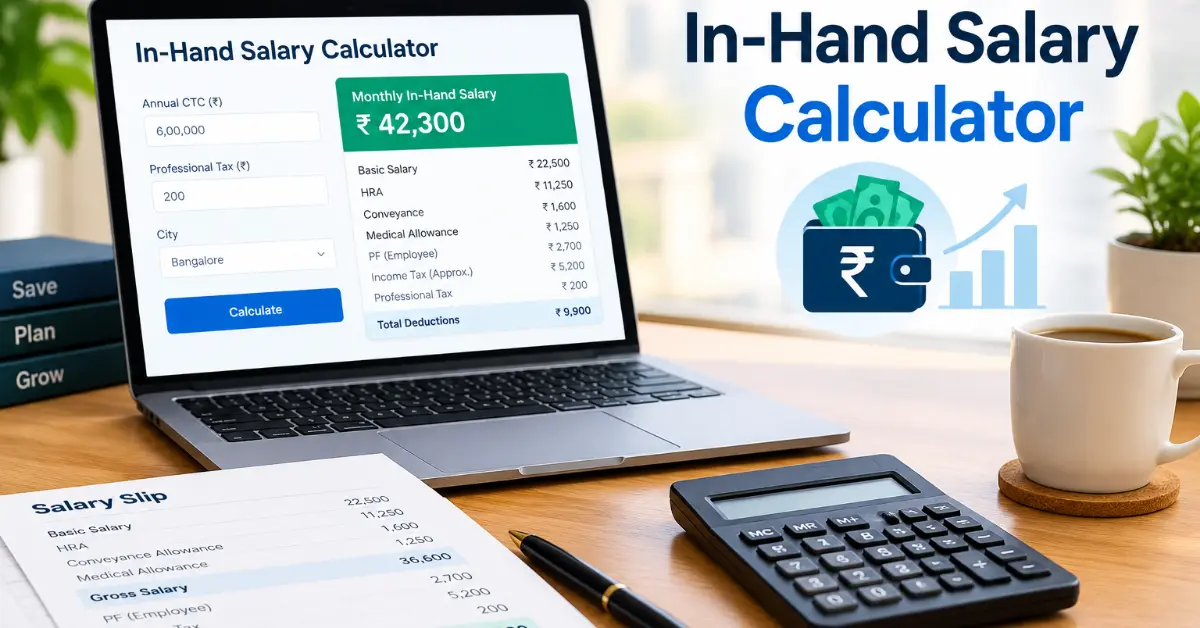
While it’s tempting to use an in-hand salary calculator to calculate how much you’ll get before you land a new job, understanding the salary offered by a company can sometimes be confusing. An offer letter may show a CTC of ₹6 lakh, ₹8 lakh, or ₹10 lakh per year, but the amount you’ll receive in your bank account every month will be different.
CTC can include many components such as basic salary, HRA, allowances, employer contributions, bonuses, and other benefits. Your salary may also include deductions such as employee PF, professional tax, income tax, and other applicable deductions.
Our In-Hand Salary Calculator helps you estimate how much salary you may receive every month after these deductions.
In-Hand Salary Calculator
Use the calculator above to enter your salary details and get an estimated monthly and annual take-home salary.
Depending on the information you provide, the calculator can show:
- Annual CTC
- Monthly CTC
- Basic salary
- HRA
- Special allowance
- Bonus
- Gross salary
- Employee PF
- Professional tax
- Income tax
- Other deductions
- Total deductions
- Estimated monthly in-hand salary
- Estimated annual in-hand salary
The calculator is designed to give you a quick estimate. Your actual salary may be different because every employer can have a different salary structure.
What Is In-Hand Salary?
In-hand salary is the amount you receive after applicable deductions are removed from your salary.
It is also commonly called take-home salary or net salary.
For example, if your monthly gross salary is ₹50,000, you may not receive the entire ₹50,000 in your bank account. Employee PF, professional tax, income tax, and other applicable deductions may be removed first.
The remaining amount is your estimated in-hand salary.
A simple way to understand the calculation is:
Gross Salary − Applicable Deductions = In-Hand Salary
However, the calculation can be more complicated when your CTC contains employer contributions, bonuses, or other components.
CTC vs Gross Salary vs In-Hand Salary
These terms are often used when discussing job offers, but they do not mean the same thing.
| Salary Term | Meaning |
|---|---|
| CTC | The overall cost a company may incur for an employee |
| Gross Salary | Salary before employee-side deductions |
| In-Hand Salary | Amount received after applicable deductions |
For example, an employee may receive an offer with a CTC of ₹8,00,000 per year. That does not necessarily mean the employee will receive ₹66,667 every month.
The CTC may contain employer PF, gratuity, bonus, insurance, or other components.
This is why checking the complete salary breakup is important.
How Is In-Hand Salary Calculated?
The calculation usually starts by understanding the salary structure.
Step 1: Find Your CTC
CTC means Cost to Company. It can include salary paid directly to you as well as certain employer contributions and benefits.
Step 2: Calculate Gross Salary
Gross salary generally includes components such as basic salary, HRA, allowances, and other salary components.
Step 3: Identify Employee Deductions
Depending on your employment and applicable rules, deductions can include:
- Employee PF
- Professional tax
- Income tax
- Other deductions
Step 4: Calculate Take-Home Salary
After applicable deductions are considered, the remaining amount is your estimated in-hand salary.
In-Hand Salary = Gross Salary − Employee Deductions
The exact calculation depends on your salary structure and applicable rules.
In-Hand Salary Calculator
Calculate your estimated monthly and annual take-home salary from your CTC.
Calculations are estimates. Actual take-home salary may vary depending on your employer’s salary structure, PF rules, professional tax, exemptions, deductions and applicable income-tax rules.
Detailed Salary Breakup
| Component | Monthly | Annual |
|---|
Where Your Salary Goes
What is an In-Hand Salary?
In-hand salary, also called take-home salary, is the amount that actually gets credited to your bank account every month after your employer subtracts all applicable deductions from your gross pay. It is different from your CTC (Cost to Company), which is the total yearly cost your employer bears to employ you, including several components that never actually reach your bank account, such as the employer’s contribution to your provident fund or any insurance premiums the company pays on your behalf.
How is In-Hand Salary Calculated?
Your salary structure generally moves through three layers. The first is CTC, the broadest figure that includes your fixed pay, variable pay, bonuses, and employer-side contributions. From this, employer contributions and certain non-cash benefits are set aside to arrive at your gross salary — the amount that is actually paid out or shown on your payslip before deductions. From gross salary, items such as your own provident fund contribution, professional tax, income tax deducted at source, and any other recurring deductions are subtracted. What remains is your in-hand or net salary — the number that actually lands in your account.
CTC vs Gross Salary vs In-Hand Salary
| Term | What it Includes | Do You Receive it Directly? |
|---|---|---|
| CTC | Basic, HRA, allowances, bonus, employer PF, and other employer costs | No — it’s the total cost to the company, not a payout figure |
| Gross Salary | Basic, HRA, allowances and bonus, before any deductions | Partially — this is the base before tax and PF are removed |
| In-Hand Salary | Gross salary minus PF, professional tax, income tax and other deductions | Yes — this is what is credited to your bank account |
What Deductions Affect Your Salary?
Provident Fund (PF): Both you and your employer typically contribute a percentage of your basic salary towards your retirement corpus under the Employees’ Provident Fund scheme. Only your own contribution reduces your in-hand pay.
Professional Tax: A small state-level tax deducted monthly, with the amount varying by state and, in some states, not applicable at all.
Income Tax (TDS): Your employer estimates your annual tax liability under the tax regime you choose and deducts a portion every month as tax deducted at source.
Other Deductions: This can include items like loan repayments, insurance premiums, or voluntary contributions that your employer deducts on your behalf.
Example Calculation
Suppose an employee has an Annual CTC of ₹6,00,000, with Basic Salary set at 40% of CTC and HRA at 50% of Basic. After accounting for a Special Allowance, a small annual bonus, employee PF contribution, professional tax and estimated income tax under the chosen regime, the estimated take-home pay typically works out to a figure noticeably lower than CTC divided by 12. This is a hypothetical example only — your own numbers will vary based on your actual salary structure, city, and applicable tax rules. Use the calculator above with your real figures for a personalised estimate.
Frequently Asked Questions
Why is my in-hand salary lower than my CTC?
CTC includes several components you never receive directly, such as the employer’s share of provident fund and other employer-side costs. Your in-hand salary is what remains after these components and your own deductions are removed from the payable portion of your salary.
What is the difference between gross salary and net salary?
Gross salary is your pay before deductions such as PF, professional tax and income tax. Net salary, or in-hand salary, is what’s left after all these deductions are subtracted.
Which tax regime should I choose, old or new?
It depends on how many deductions and exemptions you claim. The old regime allows exemptions like HRA and investments under Section 80C, while the new regime offers lower slab rates but fewer exemptions. Comparing both using your actual numbers is the best way to decide.
Is professional tax the same across India?
No. Professional tax is levied by state governments, so the amount and applicability differ from state to state, and a few states do not levy it at all.
Does this calculator guarantee my exact payslip amount?
No. This tool provides an estimate based on the inputs and assumptions you provide. Your actual payslip may differ based on your employer’s specific salary structure, exemptions you claim, and other factors this calculator cannot account for.
Does the employer’s PF contribution reduce my in-hand salary?
No. Only your own employee PF contribution is deducted from your pay. The employer’s contribution is a separate cost to the company and does not reduce your take-home pay directly.
Why do I still see some tax deducted even though my income is below the rebate limit?
Employers estimate tax liability based on declared and provided information at the start or during the financial year. If proofs of exemptions or deductions are submitted late, more tax may be withheld initially and adjusted later, or refunded when you file your return.
Can bonus amounts change my tax slab?
Yes. Since bonus is added to your annual taxable income, a large bonus can push part of your income into a higher tax slab for that year, which may increase the tax deducted.
What Is Included in CTC?
CTC can contain several different components.
Common components include:
Basic Salary
Basic salary is an important component of many salary structures. Several other salary components and contributions can be calculated using basic salary.
HRA
HRA stands for House Rent Allowance. It is commonly included in the salary structure of employees.
The tax treatment of HRA can depend on applicable rules and the employee’s circumstances.
Special Allowance
Companies may use special allowance as part of the salary structure. The amount can vary from one employer to another.
Bonus
Some companies include an annual or performance-based bonus in CTC. If a bonus is part of CTC, it may not necessarily be paid as an equal amount every month.
Employer Contributions
CTC may also include employer contributions such as the employer’s PF contribution or other benefits.
Because of these components, CTC should not simply be divided by 12 to estimate monthly in-hand salary.
What Deductions Can Reduce Your Take-Home Salary?
Several deductions may affect your monthly salary.
Employee PF
Provident Fund contributions may be deducted from an employee’s salary when applicable.
The employee’s contribution reduces the amount received as monthly take-home salary, while the contribution is credited toward the employee’s PF account according to applicable rules.
Professional Tax
Professional tax is a state-level tax applicable in certain parts of India.
The amount and applicability depend on the relevant state rules and the employee’s salary.
Income Tax
Income tax may also affect your take-home salary when tax is applicable.
The amount depends on factors such as taxable income, the applicable tax regime, deductions or exemptions where relevant, and the financial year.
Tax rules can change, so salary calculations should always be checked against the rules applicable to the relevant financial year.
Other Deductions
Depending on the employer and employee, other deductions may also appear on a salary slip.
These could include insurance premiums, employee welfare contributions, or other company-specific deductions.
In-Hand Salary Examples
The following examples are only for understanding how salary components can affect take-home pay. They are not guaranteed salary figures.
Example 1: ₹5 Lakh CTC
Suppose an employee receives a CTC of ₹5,00,000 per year.
The package may contain:
- Basic salary
- HRA
- Allowances
- Employer contributions
- Bonus
- Employee deductions
The actual in-hand salary depends on the company’s salary structure and applicable deductions.
Therefore, ₹5,00,000 ÷ 12 should not automatically be treated as the monthly take-home salary.
Example 2: ₹8 Lakh CTC
An employee with an ₹8,00,000 CTC may have a different salary breakup from another employee earning the same CTC.
One company may include a larger bonus or employer contribution, while another may have a different basic salary and allowance structure.
As a result, their monthly in-hand salaries can be different even though their CTC is the same.
Example 3: ₹10 Lakh CTC
The same principle applies to a ₹10 lakh package.
Before comparing two job offers, check:
- Fixed salary
- Variable pay
- Bonus
- Employer contributions
- Employee deductions
- Tax implications
- Expected monthly take-home salary
This gives you a better idea of the actual value of the offer.
Why Can Two People With the Same CTC Have Different In-Hand Salaries?
It is possible for two employees with the same CTC to receive different take-home salaries.
For example, their employers may use different salary structures.
One employee may have:
- Higher basic salary
- Different HRA
- Different allowances
- Different bonus structure
- Different deductions
The employee’s individual tax situation can also affect the final amount.
Therefore, CTC alone is not enough to determine exact in-hand salary.
Monthly Salary vs Annual Salary
Salary is often displayed as an annual figure in job advertisements.
For example:
₹9,00,000 per annum = ₹9 LPA
However, the monthly amount cannot always be calculated simply as:
₹9,00,000 ÷ 12 = ₹75,000
₹75,000 is only the monthly equivalent of the annual amount. It is not necessarily the monthly in-hand salary.
The actual monthly take-home amount depends on the salary breakup and deductions.
How to Use the In-Hand Salary Calculator
Using the calculator is simple.
1. Enter Your Annual CTC
Enter the CTC mentioned in your job offer or salary structure.
2. Enter Your Basic Salary
If your employer provides the basic salary percentage or amount, enter it in the calculator.
3. Add HRA and Allowances
Enter the HRA and other relevant salary components.
4. Add Bonus
If your CTC includes an annual bonus, enter the applicable amount.
5. Enter Deductions
Add employee PF, professional tax, and other deductions where applicable.
6. Select the Applicable Tax Regime
Choose the relevant tax regime if the calculator provides this option.
7. Calculate
Click Calculate Salary to view the estimated salary breakup and take-home salary.
What Is a Good Way to Compare Job Offers?
When comparing two job offers, don’t look only at the CTC.
For example:
Company A: ₹9 LPA CTC
Company B: ₹10 LPA CTC
At first glance, Company B appears to offer more.
But if a large portion of Company B’s CTC consists of variable pay, bonus, or other components, the fixed monthly salary could be closer than expected.
A better comparison includes:
- Fixed annual salary
- Monthly gross salary
- Variable pay
- Bonus
- Employer contributions
- Monthly deductions
- Estimated monthly in-hand salary
This can help you understand the practical difference between the offers.
CTC, Gross Salary and In-Hand Salary: Simple Example
Imagine a hypothetical employee whose salary package contains several components.
Annual CTC
↓
Salary components
Basic + HRA + Allowances + Bonus + Employer contributions
↓
Gross Salary
↓
Employee deductions
PF + Professional Tax + Income Tax + Other deductions
↓
Estimated In-Hand Salary
This is why the amount shown as CTC and the amount credited to your bank account are usually different.
Frequently Asked Questions
Is CTC the same as in-hand salary?
No. CTC and in-hand salary are different. CTC represents the overall cost to the company and can contain components that are not directly paid as monthly take-home salary.
How do I calculate my monthly take-home salary?
You need to consider your salary structure and applicable deductions. Enter your salary details into the calculator above to get an estimated monthly take-home salary.
Does employee PF reduce in-hand salary?
Yes. When an employee PF contribution is deducted from salary, it reduces the amount received as take-home pay.
Does employer PF reduce my salary?
Employer PF is generally part of the employer’s contribution and may be included in CTC. It is different from the employee PF deduction shown on your salary slip.
Is CTC divided by 12 equal to monthly in-hand salary?
No. Dividing CTC by 12 gives the monthly equivalent of the CTC, not necessarily your take-home salary.
Why is my salary lower than the amount mentioned in my offer letter?
The offer letter may show CTC or gross salary. Applicable deductions and components such as employer contributions or variable pay can make your actual monthly take-home amount lower.
Can my in-hand salary change from month to month?
Yes. Salary credits can vary because of bonuses, variable pay, tax adjustments, unpaid leave, changes in deductions, or other payroll adjustments.
Which tax regime should I choose?
The better tax regime depends on your individual income, eligible deductions, exemptions, and the rules applicable to the relevant financial year. Compare your tax liability under the applicable options before making a decision.
Important Things to Check on Your Salary Slip
Your salary slip can help you understand exactly how your monthly salary is calculated.
Look for:
- Basic salary
- HRA
- Allowances
- Gross earnings
- Employee PF
- Professional tax
- Income tax/TDS
- Other deductions
- Net salary
The net salary shown on your payslip is generally the amount you receive after the deductions recorded by your employer.
Final Thoughts
Accepting a job offer can be a good idea to use a calculator to figure out your take-home salary before planning your monthly budget. Use the take-home salary calculator above to estimate your monthly and annual take-home salary based on your salary details. You should note that for the most accurate estimate, always compare your employment records and pay slips and check applicable tax and payroll laws.
Disclaimer
This calculator and article are provided for general informational purposes. The calculator produces an estimate and should not be considered financial, tax, payroll, or legal advice. Actual salary may vary depending on the employer’s salary structure, applicable tax rules, PF rules, professional tax, benefits, deductions, and individual circumstances. Tax and other government rules may change, so verify the applicable rules for the relevant financial year.