Millions of central and state government employees in India get their salaries every month. But they celebrate their salary without paying attention to each number on their pay slip. Very few understand what certain numbers on the pay slip mean.
Here you will learn how to read a government employee’s pay slip step by step, understand each income and deduction element, and calculate your actual incoming salary using a real example.
What is a Salary Slip?
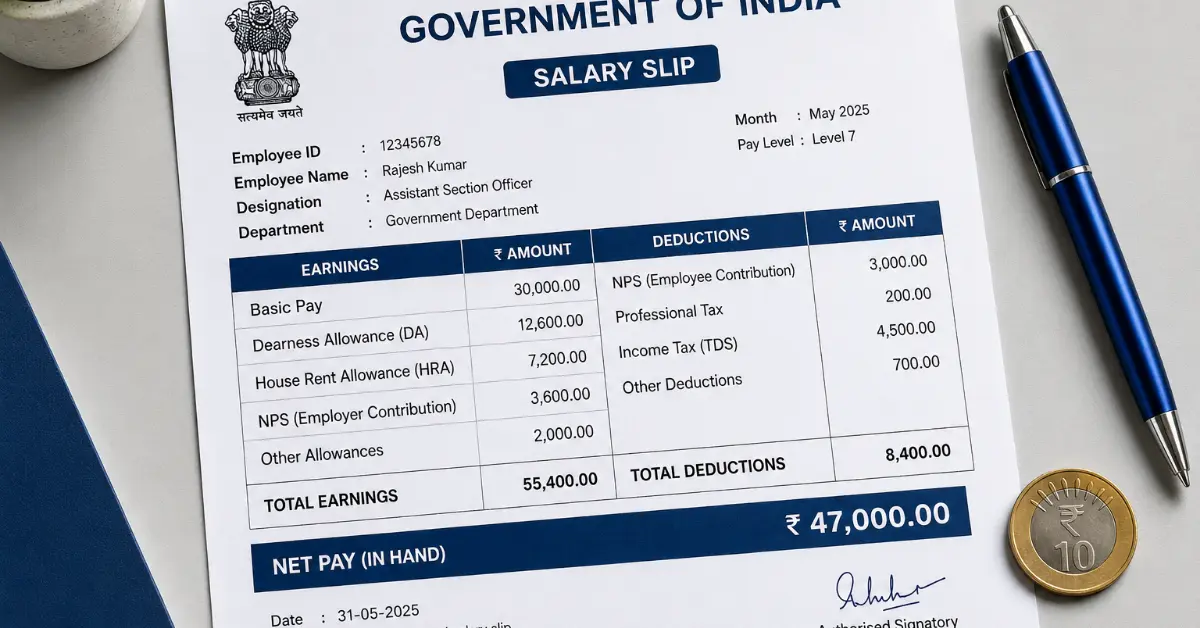
A salary slip (also called a payslip or pay stub) is an official monthly document issued by your employer. It shows:
- How much you earned (all earnings and allowances)
- How much was deducted (taxes, pension, insurance)
- Your final take-home or net pay
For central government employees, the salary slip is governed by the 7th Pay Commission structure, implemented from January 1, 2016. It covers over 33 lakh central government employees across all departments.
Important: Your salary slip is not just a formality. You need it for home loan applications, income tax filing, rent agreements, visa applications, and bank account verification. Always save a copy every month.
Structure of a Government Salary Slip
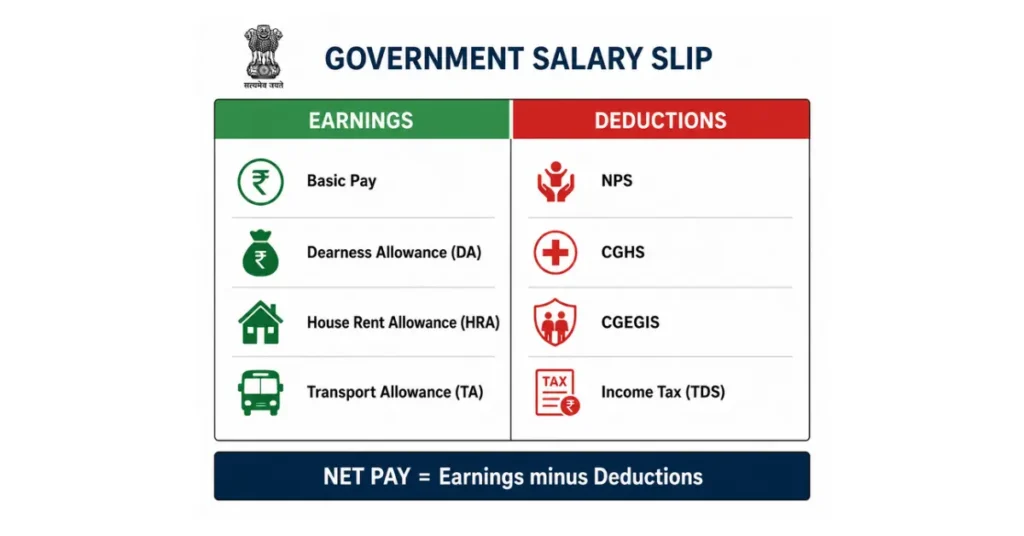
A standard central government salary slip is divided into two main sections:
| Section | What it Contains |
|---|---|
| Earnings (Left Side) | Basic Pay, DA, HRA, TA, and other allowances |
| Deductions (Right Side) | NPS, CGHS, CGEGIS, Income Tax (TDS), and other deductions |
| Net Pay (Bottom) | Gross Earnings minus Total Deductions |
The formula is simple:
Net Pay (In-Hand) = Total Gross Earnings – Total Deductions
Part 1: Earnings Side of the Salary Slip
1. Basic Pay
Basic Pay is the most important number on your salary slip. Everything else — DA, HRA, NPS contribution — is calculated as a percentage of your Basic Pay.
Under the 7th Pay Commission, Basic Pay is determined by your Pay Level in the Pay Matrix. There are 18 Pay Levels, from Level 1 (entry-level MTS/Group D) to Level 18 (Cabinet Secretary).
Common Pay Levels and Basic Pay (2026):
| Pay Level | Post Examples | Starting Basic Pay |
|---|---|---|
| Level 1 | MTS, Group D | ₹18,000 |
| Level 4 | LDC, Junior Clerk | ₹25,500 |
| Level 6 | Upper Division Clerk (UDC) | ₹35,400 |
| Level 7 | Inspector, ASO | ₹44,900 |
| Level 10 | Section Officer, Gazetted Officer | ₹56,100 |
| Level 13 | Senior Administrative Grade | ₹1,23,100 |
| Level 17 | Special Secretary | ₹2,25,000 |
Your Basic Pay increases by 3% every year as an Annual Increment, typically credited in July.
2. Dearness Allowance (DA)
DA is the inflation protection allowance paid by the government to help employees cope with rising prices. It is calculated as a percentage of your Basic Pay.
Key facts about DA in 2026:
- DA is currently 60% of Basic Pay (effective January 1, 2026, revised from 58%)
- DA is revised twice every year — in January and July — based on the All India Consumer Price Index for Industrial Workers (AICPI-IW)
- DA is uniform across all Pay Levels — the percentage is the same for everyone, only the rupee amount differs because Basic Pay differs
DA Calculation Example:
Basic Pay = ₹44,900 (Level 7) DA = 60% of ₹44,900 = ₹26,940 per month
The 8th Pay Commission, currently under consultation as of mid-2026, is expected to reset DA to 0% when implemented — merging the accumulated DA into a new higher Basic Pay.
3. House Rent Allowance (HRA)
HRA is paid to help employees meet their housing expenses. The rate depends on which city you are posted in. The government classifies all cities into three categories — X, Y, and Z.
HRA Rates in 2026 (after DA crossed 50%):
| City Class | Examples | HRA Rate |
|---|---|---|
| X Class (Metro) | Delhi, Mumbai, Bengaluru, Chennai, Kolkata, Hyderabad | 30% of Basic Pay |
| Y Class (Major Cities) | Jaipur, Lucknow, Patna, Bhopal, Nagpur, Surat | 20% of Basic Pay |
| Z Class (Other Cities/Towns) | All remaining towns and areas | 10% of Basic Pay |
HRA Calculation Example (Level 7, posted in Y-class city):
Basic Pay = ₹44,900 HRA = 20% of ₹44,900 = ₹8,980 per month
HRA rates are set to rise again when DA crosses 75% — the next anticipated trigger point.
4. Transport Allowance (TA)
Transport Allowance is given to help employees commute to their workplace. It is a fixed monthly amount that varies by Pay Level and city class.
Transport Allowance Rates (2026):
| Pay Level | TA in X/Y Class Cities | TA in Z Class Cities |
|---|---|---|
| Level 1 to 2 | ₹1,350 | ₹900 |
| Level 3 to 8 | ₹3,600 | ₹1,800 |
| Level 9 and above | ₹7,200 | ₹3,600 |
In addition to the base TA amount, you also receive DA on TA — which is Dearness Allowance calculated on the TA amount. At 60% DA:
TA = ₹3,600 (Level 7, X/Y city) DA on TA = 60% of ₹3,600 = ₹2,160 Total TA received = ₹5,760 per month
5. Other Allowances
Depending on your department, cadre, and posting, you may receive additional allowances such as:
| Allowance | Who Gets It |
|---|---|
| Medical Allowance | Employees not covered by CGHS |
| Children’s Education Allowance | Up to ₹2,812/month per child (2 children max) |
| Hostel Subsidy | For children staying in hostel away from parents |
| Special Duty Allowance | For postings in North East, Jammu & Kashmir, Ladakh |
| Night Duty Allowance | For employees working night shifts |
| Risk Allowance | For hazardous job profiles |
These are not shown on every payslip — only on those applicable to your specific posting.
Part 2: Deductions Side of the Salary Slip
1. NPS — National Pension System
NPS is the most significant deduction for government employees appointed after January 1, 2004. It is your monthly contribution toward your retirement pension.
- Employee contribution: 10% of (Basic Pay + DA)
- Government’s contribution: 14% of (Basic Pay + DA) — paid separately by the government, not deducted from your salary
NPS Deduction Example (Level 7):
Basic Pay = ₹44,900 | DA = ₹26,940 Basic + DA = ₹71,840 NPS deduction = 10% of ₹71,840 = ₹7,184 per month
Note for pre-2004 employees: If you were appointed before January 1, 2004, you are under the Old Pension Scheme (OPS) and contribute to GPF (General Provident Fund) instead of NPS. From April 2025, employees can also choose the Unified Pension Scheme (UPS) — the NPS deduction percentage remains 10% either way.
2. CGHS — Central Government Health Scheme
CGHS provides comprehensive medical care to central government employees and their families. A monthly subscription is deducted from salary.
CGHS Subscription Rates (2026):
| Pay Level | Monthly CGHS Deduction |
|---|---|
| Level 1 to 5 | ₹250 |
| Level 6 | ₹450 |
| Level 7 to 11 | ₹650 |
| Level 12 and above | ₹1,000 |
Employees in areas not covered by CGHS receive a Medical Allowance of ₹1,000 per month instead.
3. CGEGIS — Central Government Employees Group Insurance Scheme
CGEGIS is a group life insurance and savings scheme. A small monthly premium is deducted automatically.
CGEGIS Monthly Premium (2026):
| Group | Pay Level | Monthly Premium |
|---|---|---|
| Group A | Level 10 and above | ₹120 |
| Group B | Level 6 to 9 | ₹60 |
| Group C | Level 1 to 5 | ₹30 |
4. Income Tax (TDS)
TDS (Tax Deducted at Source) under Section 192 of the Income Tax Act is the income tax deducted monthly from your salary by your employer (the government department) and deposited directly with the Income Tax Department.
How TDS is calculated:
- Your employer estimates your total annual income
- Calculates the tax liability based on the tax regime you have chosen
- Divides it by 12 and deducts that amount every month
Tax Regime in 2026: The New Tax Regime is now the default regime for all employees from FY 2025-26. Under the New Tax Regime:
- Standard Deduction of ₹75,000 is available
- Income up to ₹12 lakh is effectively tax-free under Section 87A rebate
- Most employees at Level 1 to Level 7 pay zero or very low TDS
Under the New Tax Regime, only the Standard Deduction and employer’s NPS contribution (up to 14% of Basic + DA) are available as deductions.
5. Professional Tax
Professional Tax is a state government levy deducted from salary in certain states. It is typically ₹200 per month. Not all states charge it.
States where Professional Tax applies: Karnataka, Maharashtra, West Bengal, Andhra Pradesh, Telangana, Tamil Nadu, Gujarat, Kerala, Chhattisgarh, Madhya Pradesh, Odisha, Assam, Jharkhand, Bihar, Tripura, Meghalaya.
If you are posted in any of these states, you will see a ₹150–₹200 deduction under Professional Tax.
Part 3: A Complete Worked Example
Let us now calculate the full salary slip for a Level 7 government employee (e.g., an Inspector or Assistant Section Officer) posted in a Y-class city in 2026.
Employee Details:
- Pay Level: 7
- Basic Pay: ₹44,900
- City Class: Y (e.g., Jaipur, Lucknow)
- DA Rate: 60% (January 2026)
- Appointed after 2004 (NPS applicable)
- CGHS applicable
Earnings:
| Component | Calculation | Amount |
|---|---|---|
| Basic Pay | As per Pay Matrix | ₹44,900 |
| Dearness Allowance (DA) | 60% of ₹44,900 | ₹26,940 |
| House Rent Allowance (HRA) | 20% of ₹44,900 (Y-class) | ₹8,980 |
| Transport Allowance (TA) | Fixed for Level 7 | ₹3,600 |
| DA on TA | 60% of ₹3,600 | ₹2,160 |
| Gross Total | ₹86,580 |
Deductions:
| Component | Calculation | Amount |
|---|---|---|
| NPS (Employee) | 10% of (₹44,900 + ₹26,940) | ₹7,184 |
| CGHS Subscription | Level 7 rate | ₹650 |
| CGEGIS Premium | Group B rate | ₹60 |
| Income Tax (TDS) | Approx. (below ₹12L tax-free) | ₹0 |
| Professional Tax | If applicable in state | ₹200 |
| Total Deductions | ₹8,094 |
Net In-Hand Pay:
| Amount | |
|---|---|
| Gross Earnings | ₹86,580 |
| Total Deductions | ₹8,094 |
| Net Pay (In-Hand) | ₹78,486 |
So while the Basic Pay is ₹44,900, this employee actually receives approximately ₹78,486 in hand every month — nearly 75% more than the Basic Pay figure that appears in job notifications.
How to Download Your Government Salary Slip Online
Central government employees can access their monthly salary slip through official portals:
| Portal | Who Uses It |
|---|---|
| PFMS (pfms.nic.in) | Most central government departments |
| SPARROW | IAS officers and Group A services |
| HRMS (ministry-specific) | Railways, Defence, Posts, Doordarshan, ESIC |
| DDO Office | Your establishment section — can issue printed copy |
Banks and financial institutions accept the PFMS-generated salary slip as official proof of income for loan applications.
Common Mistakes to Avoid When Reading Your Salary Slip
Mistake 1: Confusing Basic Pay with In-Hand Salary Many job aspirants assume the Pay Level basic pay is what they will receive. In reality, in-hand pay is significantly higher due to DA, HRA, and TA additions — but also lower than gross due to NPS and other deductions.
Mistake 2: Not Checking DA Rate DA changes twice a year. Always verify the DA rate shown on your slip matches the current official rate. In January 2026, DA was revised to 60%.
Mistake 3: Not Updating Tax Regime Choice If you do not declare your preferred tax regime to your employer at the start of the financial year, TDS will be deducted under the New Tax Regime by default.
Mistake 4: Ignoring NPS Accumulation Your NPS deduction is not a loss — it is building your retirement corpus. The government also adds 14% of your Basic + DA every month to your NPS account, which does not appear as a deduction because it is the government’s own contribution.
Frequently Asked Questions
Q: What is the difference between Gross Salary and Net Salary? Gross Salary is the total of all your earnings before deductions — Basic Pay + DA + HRA + TA + all allowances. Net Salary (in-hand) is what you actually receive after all deductions like NPS, CGHS, and TDS are subtracted.
Q: Does HRA change if I get transferred to another city? Yes. HRA is linked to your posting location. If you are transferred from a Y-class city to an X-class city, your HRA will increase from 20% to 30% of Basic Pay automatically.
Q: Is DA the same for all government employees? The DA percentage is the same for all central government employees regardless of level. However, the rupee amount differs because it is calculated as a percentage of your Basic Pay.
Q: What happens to my NPS deduction at retirement? At retirement (age 60 or superannuation), you can withdraw 60% of the NPS corpus as a tax-free lump sum. The remaining 40% must be used to purchase an annuity that provides a monthly pension.
Q: Can I see how much the government contributes to my NPS? Yes. Log in to the NPS portal at npscra.nsdl.co.in using your PRAN (Permanent Retirement Account Number) to see both your own contributions and the government’s 14% contribution credited each month.
Q: What is CGEGIS and is it compulsory? CGEGIS (Central Government Employees Group Insurance Scheme) is mandatory for all central government employees. It is a combined savings and insurance scheme — one portion goes to a savings fund and another to a risk insurance fund.
Summary: Key Components at a Glance
| Component | Type | Rate / Amount |
|---|---|---|
| Basic Pay | Earning | As per Pay Matrix (Level 1 to 18) |
| Dearness Allowance | Earning | 60% of Basic (Jan 2026) |
| HRA | Earning | 30% / 20% / 10% (X/Y/Z city) |
| Transport Allowance | Earning | ₹1,350 to ₹7,200 + DA on TA |
| NPS Deduction | Deduction | 10% of (Basic + DA) |
| CGHS | Deduction | ₹250 to ₹1,000/month |
| CGEGIS | Deduction | ₹30 to ₹120/month |
| Income Tax (TDS) | Deduction | Based on annual income and tax slab |
| Professional Tax | Deduction | ~₹200/month (state-specific) |
Conclusion
Reading your government salary slip is not complicated once you understand the structure. The key points to remember are:
- Your Basic Pay is the foundation — everything else is calculated from it
- DA at 60% significantly boosts your gross salary in 2026
- HRA depends on your city class (X, Y, or Z)
- NPS deduction of 10% is your contribution toward retirement — the government adds another 14%
- Your actual in-hand salary is always much more than the Basic Pay in the job notification, and lower than the Gross due to deductions
If you are a government job aspirant, understanding salary slips also helps you evaluate and compare job offers across departments, pay levels, and posting cities.
Disclaimer: All figures mentioned in this article are based on 7th Pay Commission rates and publicly available government notifications as of June 2026. DA rates, HRA classification, and other components are subject to revision by the government. Always verify current rates from your office’s Drawing and Disbursing Officer (DDO) or official Ministry of Finance notifications.
Also Read: [7th Pay Commission Salary Slip Format – All Deductions Explained] | [How to Calculate In-Hand Salary from CTC] | [DA Hike January 2026 – Impact on Government Salary]