Central employees get an additional slip when they get their salary, but many people don’t look at it. But your salary slip under the 7th Pay Commission is a detailed financial proof because it shows you exactly what was taken before the money reached your bank account.
If you look carefully at this, you can see if there are any errors in your salary. This slip gives you the assurance you need to plan your taxes, apply for loans, and prepare for the upcoming 8th Pay Commission.
What is the 7th Pay Commission?
The 7th Central Pay Commission (7th CPC) was constituted by the Government of India in February 2014 under the chairmanship of Justice Ashok Kumar Mathur. Its recommendations were implemented from January 1, 2016, covering over 33 lakh central government employees and 52 lakh pensioners.
Key changes the 7th CPC introduced:
| Change | Detail |
|---|---|
| New Pay Structure | Replaced Pay Bands + Grade Pay with a single Pay Matrix |
| Pay Levels | 18 levels (Level 1 = entry to Level 18 = Cabinet Secretary) |
| Fitment Factor | 2.57 applied uniformly to all employees |
| Minimum Pay | Raised from ₹7,000 to ₹18,000 per month |
| Annual Increment | Fixed at 3% of Basic Pay (same as 6th CPC) |
| Implementation Date | January 1, 2016 |
The 7th CPC Pay Matrix is a grid: vertical axis shows Pay Levels (1–18), horizontal axis shows annual increment stages (1–40). Each cell in the matrix is a specific Basic Pay value. Your pay progresses horizontally by one cell every year on July 1 as your annual increment.
8th Pay Commission update: The 8th CPC was formally constituted on November 3, 2025 under Justice Ranjana Prakash Desai. Its report is expected around mid-2027, with implementation likely from January 2028. Until then, the 7th Pay Commission remains the official pay framework for all central government employees.
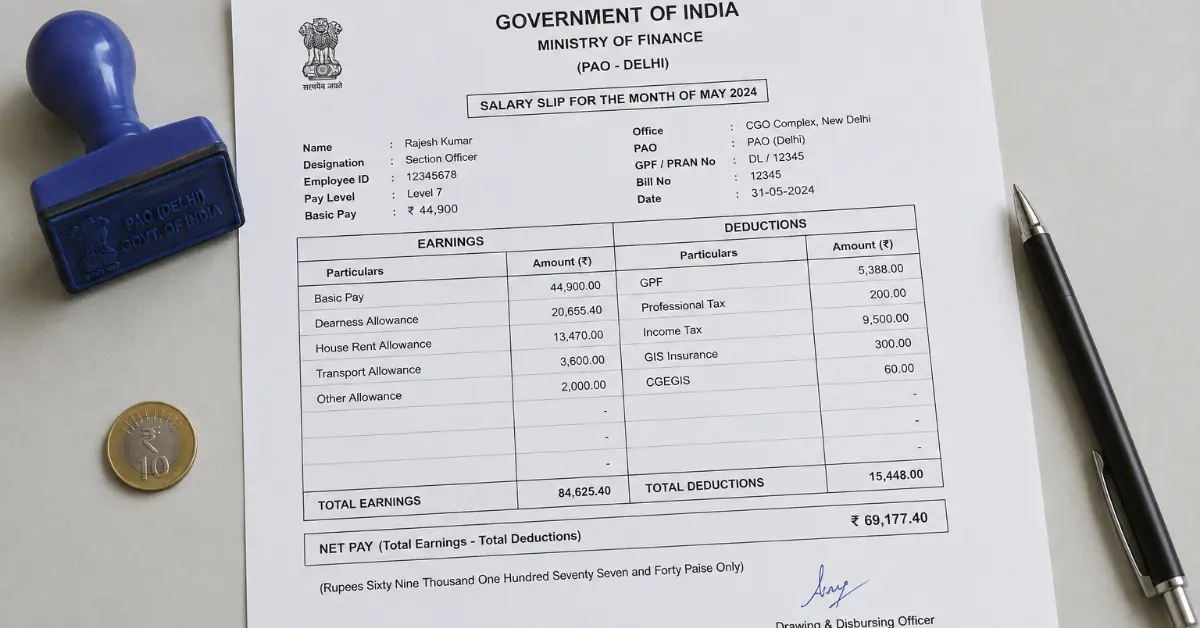
The Standard 7th CPC Salary Slip Format
A central government salary slip has a standard two-column layout:
┌─────────────────────────────────────────────────────────────┐
│         GOVERNMENT OF INDIA — SALARY SLIP                   │
│         Month: June 2026                                    │
├──────────────────────────────┬──────────────────────────────┤
│ Employee Name:               │ Department:                  │
│ Employee Code:               │ Designation:                 │
│ PAN:                         │ Pay Level:                   │
│ PRAN (NPS):                  │ Bank A/c No.:                │
├──────────────────────────────┼──────────────────────────────┤
│         EARNINGS             │         DEDUCTIONS           │
├──────────────────────────────┼──────────────────────────────┤
│ Basic Pay           ₹ _____ │ NPS (Employee 10%) ₹ _____   │
│ Dearness Allowance  ₹ _____ │ CGHS Subscription  ₹ _____   │
│ HRA                 ₹ _____ │ CGEGIS Premium     ₹ _____   │
│ Transport Allowance ₹ _____ │ Income Tax (TDS)   ₹ _____   │
│ DA on TA            ₹ _____ │ Professional Tax   ₹ _____   │
│ Other Allowances    ₹ _____ │ Other Deductions   ₹ _____   │
├──────────────────────────────┼──────────────────────────────┤
│ GROSS TOTAL         ₹ _____ │ TOTAL DEDUCTIONS   ₹ _____   │
├──────────────────────────────┴──────────────────────────────┤
│           NET PAY (IN-HAND): ₹ _____                        │
│           NET PAY = Gross Earnings – Total Deductions        │
└─────────────────────────────────────────────────────────────┘
Every line in this format represents a real calculation. Let us go through each one.
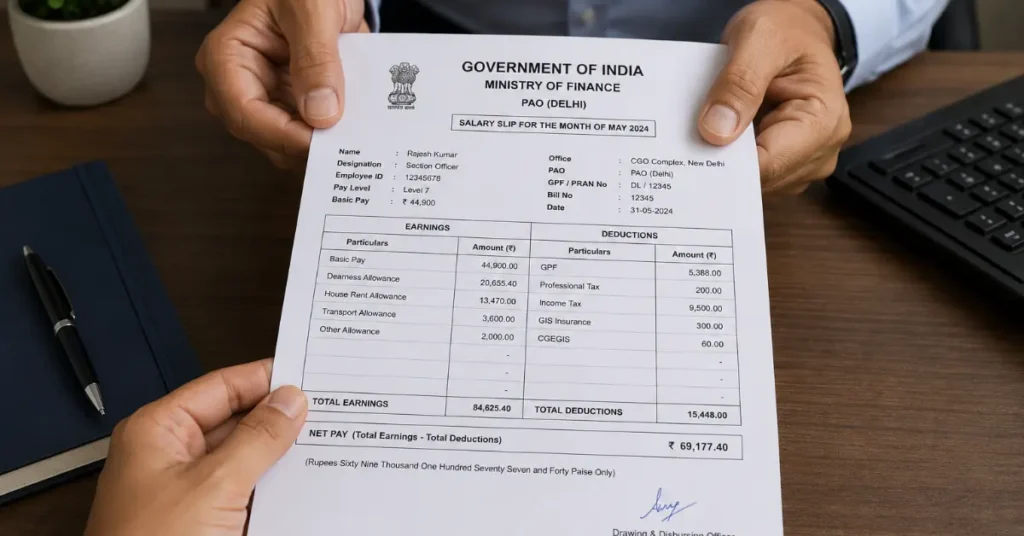
Part 1: Earnings Side — Every Component Explained
Component 1: Basic Pay
Basic Pay is the foundation of your entire salary. Every other component — DA, HRA, NPS, gratuity — is calculated as a percentage of Basic Pay. It is determined by your Pay Level and Stage in the 7th CPC Pay Matrix.
Basic Pay by common Pay Levels (Entry Stage, 2026):
| Pay Level | Post Examples | Entry Basic Pay |
|---|---|---|
| Level 1 | MTS, Peon, Group D | ₹18,000 |
| Level 2 | Junior Clerk (some departments) | ₹19,900 |
| Level 4 | LDC, Data Entry Operator | ₹25,500 |
| Level 5 | Junior Secretariat Assistant | ₹29,200 |
| Level 6 | UDC, Senior Secretariat Assistant | ₹35,400 |
| Level 7 | Inspector, ASO | ₹44,900 |
| Level 8 | AAO, ASO (CSS) | ₹47,600 |
| Level 10 | Section Officer | ₹56,100 |
| Level 12 | Under Secretary | ₹78,800 |
| Level 13 | Deputy Secretary | ₹1,23,100 |
Each July 1, your Basic Pay moves to the next cell in the matrix — a 3% increase rounded to the nearest ₹100.
Component 2: Dearness Allowance (DA)
DA is the inflation-adjustment allowance paid on top of Basic Pay. It is revised twice every year — in January and July — based on the All India Consumer Price Index for Industrial Workers (AICPI-IW) with base year 2016=100.
Current DA rate: 60% of Basic Pay (effective January 1, 2026)
The Union Cabinet approved a 2% DA hike in April 2026, increasing DA from 58% to 60%. Employees received arrears for January to March 2026 along with the April or May 2026 salary.
DA revision history:
| Period | DA Rate |
|---|---|
| January 2024 | 50% |
| July 2024 | 53% |
| January 2025 | 55% |
| July 2025 | 58% |
| January 2026 | 60% |
| July 2026 (expected) | 63% |
DA Calculation Formula:
DA = DA Rate (%) × Basic Pay Example: 60% × ₹44,900 = ₹26,940
Important: When DA crossed 50% in January 2024, it triggered an automatic revision of HRA rates upward. The next trigger point is when DA crosses 75%.
Component 3: House Rent Allowance (HRA)
HRA is paid to help employees meet housing rental expenses. The rate depends entirely on your posting city class, not your pay level.
City classification and current HRA rates (DA crossed 50%):
| City Class | Cities | HRA Rate |
|---|---|---|
| X Class | Delhi, Mumbai, Kolkata, Chennai, Bengaluru, Hyderabad, Pune | 30% of Basic Pay |
| Y Class | Jaipur, Lucknow, Patna, Bhopal, Nagpur, Surat, Visakhapatnam | 20% of Basic Pay |
| Z Class | All other cities, towns, and rural postings | 10% of Basic Pay |
HRA Calculation Examples (Basic Pay ₹44,900):
| City Class | Calculation | Monthly HRA |
|---|---|---|
| X Class | 30% × ₹44,900 | ₹13,470 |
| Y Class | 20% × ₹44,900 | ₹8,980 |
| Z Class | 10% × ₹44,900 | ₹4,490 |
Important HRA rules:
- If you are allotted government accommodation (government quarters), HRA is not paid. A licence fee is deducted instead.
- When you go on leave without pay, HRA is recalculated proportionately.
- HRA is paid on Basic Pay only — DA is not included in the HRA base.
Component 4: Transport Allowance (TA) and DA on TA
Transport Allowance is a fixed monthly amount to cover commuting costs. Unlike HRA, it is fixed by Pay Level, not as a percentage of Basic Pay.
Transport Allowance Rates (2026):
| Pay Level | TA in X/Y Class Cities | TA in Z Class Cities |
|---|---|---|
| Level 1 to 2 | ₹1,350/month | ₹900/month |
| Level 3 to 8 | ₹3,600/month | ₹1,800/month |
| Level 9 and above | ₹7,200/month | ₹3,600/month |
In addition to base TA, Dearness Allowance is also paid on TA — calculated separately on the TA amount at the current DA rate.
DA on TA Calculation (Level 7, X/Y city):
TA = ₹3,600 DA on TA = 60% × ₹3,600 = ₹2,160 Total TA received = ₹3,600 + ₹2,160 = ₹5,760/month
Note: TA is not paid on days of absence. If an employee is on leave for an entire month, TA is not payable for that month.
Component 5: Other Allowances (If Applicable)
Depending on cadre, department, and posting, employees may receive additional allowances that appear on the salary slip:
| Allowance | Eligibility |
|---|---|
| Children’s Education Allowance (CEA) | Up to ₹2,812/month per child (max 2 children) |
| Hostel Subsidy | For children in hostel away from parents |
| Special Duty Allowance | For North East, J&K, Ladakh postings |
| Risk Allowance | Hazardous job profiles |
| Night Duty Allowance | For night shift workers |
| Washing Allowance | For uniformed staff |
| Non-Practicing Allowance (NPA) | For doctors in government service |
These appear only on specific employees’ payslips based on their cadre and posting.
Part 2: Deductions Side — Every Component Explained
Deduction 1: NPS — National Pension System
NPS is the largest and most important deduction on a 7th CPC salary slip. It applies to all employees appointed on or after January 1, 2004.
Key NPS facts for 2026:
| Factor | Detail |
|---|---|
| Employee Contribution | 10% of (Basic Pay + DA) |
| Government Contribution | 14% of (Basic Pay + DA) — not a deduction |
| Investment | Automatically invested in equity + debt mix |
| At Retirement | 60% lump sum (tax-free) + 40% annuity for monthly pension |
| PRAN | Permanent Retirement Account Number — unique to each employee |
The government’s 14% contribution does not appear as a deduction on your slip — it is a separate payment made by your department directly to your NPS account.
New from April 2025 — Unified Pension Scheme (UPS):
Employees can now choose between two options:
- NPS: Market-linked returns. Government contributes 14% of Basic + DA.
- UPS: Assured pension. Government contributes 18.5% of Basic + DA. After 25 years of service, guaranteed pension of 50% of average last 12 months’ Basic Pay.
The employee contribution remains 10% for both NPS and UPS. Only the government’s contribution rate and the pension guarantee differ.
NPS Deduction Calculation (Basic ₹44,900, DA 60%):
Basic + DA = ₹44,900 + ₹26,940 = ₹71,840 NPS deduction = 10% × ₹71,840 = ₹7,184/month
For employees appointed before January 2004 (Old Pension Scheme), a GPF (General Provident Fund) subscription appears instead of NPS. GPF minimum subscription is 6% of Basic Pay, though most employees contribute more voluntarily.
Deduction 2: CGHS — Central Government Health Scheme
CGHS provides comprehensive medical coverage — cashless treatment, specialist consultations, surgeries, and medicines — for the employee and eligible family members at government hospitals and empanelled private hospitals across 89 cities in India.
CGHS Monthly Subscription Rates (2026):
| Pay Level | Monthly CGHS Deduction |
|---|---|
| Level 1 to 5 | ₹250 |
| Level 6 | ₹450 |
| Level 7 to 11 | ₹650 |
| Level 12 and above | ₹1,000 |
For employees posted in cities not covered by CGHS, a Medical Allowance of ₹1,000/month is paid instead — this appears as an earning, not a deduction.
Deduction 3: CGEGIS — Central Government Employees Group Insurance Scheme
CGEGIS is a compulsory group life insurance cum savings scheme for all central government employees. It has two components — a Risk Fund (insurance) and a Savings Fund (accumulates over service and is paid at retirement or resignation).
CGEGIS Monthly Premiums (2026):
| Employee Group | Pay Level | Monthly Premium |
|---|---|---|
| Group A | Level 10 and above | ₹120 |
| Group B | Level 6 to 9 | ₹60 |
| Group C | Level 1 to 5 | ₹30 |
Note: PayBandCalc data for 2026 shows Group B at ₹120/month and Group C at ₹60/month for updated rates — verify with your DDO as these may vary by department notification.
Deduction 4: Income Tax / TDS
Income Tax (TDS — Tax Deducted at Source) under Section 192 of the Income Tax Act is deducted monthly by your employer (your department’s DDO — Drawing and Disbursing Officer) and deposited directly with the Income Tax Department.
How TDS is calculated:
- Your DDO estimates your total annual gross income
- Subtracts eligible deductions based on your declared tax regime
- Applies the applicable tax slabs
- Divides by 12 — this monthly amount is deducted as TDS
Tax Regime in FY 2026-27: The New Tax Regime is the default for all employees from FY 2025-26 onward. Under the New Tax Regime:
- Standard Deduction: ₹75,000
- Section 87A Rebate: Up to ₹12 lakh annual income = zero tax payable
- Employer NPS contribution (14% of Basic + DA) is deductible under Section 80CCD(2)
Practical impact: Most central government employees at Level 1 to Level 7 with one or two earning family members will pay zero or minimal TDS in 2026 because their gross annual income falls below the ₹12 lakh tax-free threshold under the New Regime after Standard Deduction.
Deduction 5: Professional Tax (PT)
Professional Tax is a state government levy — not a central government one. It is applicable only in certain states and is deducted from salary if you are posted in one of those states.
States where Professional Tax is deducted: Karnataka, Maharashtra, West Bengal, Andhra Pradesh, Telangana, Tamil Nadu, Gujarat, Kerala, Chhattisgarh, Madhya Pradesh, Odisha, Assam, Jharkhand, Bihar, Tripura, Meghalaya
Typical amount: ₹150–₹200 per month (varies by state income slab)
If you are posted in Delhi, Rajasthan, Uttar Pradesh, Haryana, or Punjab — Professional Tax does not apply and this line will not appear on your salary slip.
Part 3: Three Complete Salary Slip Examples
Example 1 — Level 1 Employee (MTS / Group D), Z-Class City
Profile: Multi-Tasking Staff, newly joined, posted in a small town
| Earnings | Deductions | ||
|---|---|---|---|
| Basic Pay | ₹18,000 | NPS (10%) | ₹2,880 |
| DA (60%) | ₹10,800 | CGHS | ₹250 |
| HRA (10%, Z city) | ₹1,800 | CGEGIS | ₹30 |
| TA | ₹900 | Income Tax (TDS) | ₹0 |
| DA on TA (60%) | ₹540 | Professional Tax | ₹0 |
| Gross Total | ₹32,040 | Total Deductions | ₹3,160 |
| NET IN-HAND | ₹28,880 |
Example 2 — Level 7 Employee (Inspector / ASO), Y-Class City
Profile: Assistant Section Officer, 3 years of service, posted in Jaipur (Y-class)
| Earnings | Deductions | ||
|---|---|---|---|
| Basic Pay | ₹47,600 | NPS (10%) | ₹7,616 |
| DA (60%) | ₹28,560 | CGHS | ₹650 |
| HRA (20%, Y city) | ₹9,520 | CGEGIS | ₹60 |
| TA | ₹3,600 | Income Tax (TDS) | ₹0 |
| DA on TA (60%) | ₹2,160 | Professional Tax | ₹0 |
| Gross Total | ₹91,440 | Total Deductions | ₹8,326 |
| NET IN-HAND | ₹83,114 |
Example 3 — Level 10 Employee (Section Officer), X-Class City
Profile: Section Officer posted in Delhi (X-class), 5 years of service
| Earnings | Deductions | ||
|---|---|---|---|
| Basic Pay | ₹63,100 | NPS (10%) | ₹10,096 |
| DA (60%) | ₹37,860 | CGHS | ₹650 |
| HRA (30%, X city) | ₹18,930 | CGEGIS | ₹120 |
| TA | ₹7,200 | Income Tax (TDS) | ₹3,500 (approx.) |
| DA on TA (60%) | ₹4,320 | Professional Tax | ₹0 (Delhi) |
| Gross Total | ₹1,31,410 | Total Deductions | ₹14,366 |
| NET IN-HAND | ₹1,17,044 |
Part 4: How to Download Your 7th CPC Salary Slip
Central government employees can access their monthly salary slip through official portals:
| Portal | Who Uses It | URL |
|---|---|---|
| PFMS | Most central government departments | pfms.nic.in |
| SPARROW | IAS officers and Group A services | sparrow.gov.in |
| HRMS (Railways) | Railway employees | hrms.indianrail.gov.in |
| HRMS (Defence) | Defence civilian employees | Ministry portal |
| DDO Office | Any employee can request a printed copy | Visit your establishment section |
Banks, landlords, and financial institutions accept the PFMS-generated salary slip as official income proof for loan applications, HRA exemption claims, rent agreements, and visa applications.
Part 5: How DA Hike Impacts Your Salary Slip
Every DA revision changes multiple lines on your salary slip simultaneously:
| Salary Slip Line | Impact of DA Hike |
|---|---|
| DA (Earnings side) | Increases directly |
| DA on TA (Earnings side) | Increases because DA rate goes up |
| NPS (Deductions side) | Increases because NPS = 10% of Basic + DA |
| Gross Salary | Increases due to higher DA and DA on TA |
| Net Pay | Increases but slightly less than gross increase due to higher NPS |
Example — Impact of DA going from 58% to 60% on Level 7 salary:
| At DA 58% | At DA 60% | Increase | |
|---|---|---|---|
| Basic Pay | ₹44,900 | ₹44,900 | — |
| DA | ₹26,042 | ₹26,940 | +₹898 |
| NPS deduction | ₹7,094 | ₹7,184 | +₹90 |
| Net gain in hand | +₹808/month |
For a ₹50,000 Basic Pay employee, a 2% DA hike adds exactly ₹1,000 more to gross salary. After the slightly higher NPS deduction, the net in-hand gain is approximately ₹900 per month.
Frequently Asked Questions
Q: What is the format of a 7th Pay Commission salary slip? A 7th CPC salary slip has two columns — Earnings (Basic Pay, DA, HRA, TA, DA on TA, and other allowances) on the left, and Deductions (NPS, CGHS, CGEGIS, TDS, Professional Tax) on the right. Net Pay at the bottom equals Gross Earnings minus Total Deductions.
Q: What is the current DA rate on the 7th Pay Commission salary slip? The current Dearness Allowance rate is 60% of Basic Pay, effective January 1, 2026 (approved by the Union Cabinet on April 18, 2026). The next revision is expected in July 2026, with a projected rate of approximately 63%.
Q: What is the NPS deduction shown on the salary slip? NPS deduction is 10% of (Basic Pay + Dearness Allowance). This is the employee’s contribution. The government separately contributes 14% of (Basic + DA) to the same NPS account — this does not appear as a deduction because it is paid by the department, not deducted from your salary.
Q: What is the difference between Gross Salary and Net Salary on a 7th CPC payslip? Gross Salary is the total of all earnings before deductions — Basic Pay + DA + HRA + TA + DA on TA + any other allowances. Net Salary (in-hand) is what reaches your bank account after NPS, CGHS, CGEGIS, TDS, and other deductions are subtracted.
Q: Why does my salary slip show zero TDS? Most central government employees at Level 1 to Level 7 pay zero TDS because, under the New Tax Regime (default from FY 2025-26), income up to ₹12 lakh per year is effectively tax-free after the ₹75,000 Standard Deduction and Section 87A rebate. Only higher-level employees with gross annual income exceeding ₹12 lakh will see TDS deductions.
Q: What is CGEGIS on the salary slip? CGEGIS (Central Government Employees Group Insurance Scheme) is a mandatory group life insurance and savings scheme. The monthly premium is ₹30 (Level 1-5), ₹60 (Level 6-9), or ₹120 (Level 10+). Part of the premium goes to insurance cover, and part accumulates in a savings fund that is paid out at retirement or resignation.
Q: What happens to my salary slip when DA crosses 75%? When DA crosses 75%, it will trigger the next automatic revision in HRA rates — pushing X-class HRA from 30% to 36%, Y-class from 20% to 27%, and Z-class from 10% to 18% of Basic Pay. This will noticeably increase the Gross Salary figure on all employees’ salary slips.
Q: Can I use my salary slip as income proof for a home loan? Yes. Banks and housing finance companies accept the PFMS-generated government salary slip as official income proof, typically requiring the last 3 to 6 months of slips along with your Form 16 and bank statements.
Summary: 7th CPC Salary Slip at a Glance
| Component | Type | Rate/Amount (2026) |
|---|---|---|
| Basic Pay | Earning | As per Pay Matrix, Level 1 (₹18,000) to Level 18 |
| Dearness Allowance | Earning | 60% of Basic Pay |
| HRA | Earning | 30% / 20% / 10% (X/Y/Z city) |
| Transport Allowance | Earning | ₹900 to ₹7,200 (fixed by level) |
| DA on TA | Earning | 60% of TA amount |
| NPS | Deduction | 10% of (Basic + DA) |
| CGHS | Deduction | ₹250 to ₹1,000 (by Pay Level) |
| CGEGIS | Deduction | ₹30 to ₹120 (by Group) |
| Income Tax (TDS) | Deduction | Based on annual income & tax regime |
| Professional Tax | Deduction | ~₹200/month (state-specific) |
Conclusion
Here are some key points to look at to make things easier to understand when looking at your pay slip: First, check whether your basic pay matches your current pay level and stage in the official pay matrix.
Second, check whether the DA rate matches the current official rate – 60% from January 2026. Third, check whether your NPS deduction is exactly 10% of basic + DA. Fourth, check whether the HRA matches your correct city classification (X, Y, or Z). Fifth, check whether the net pay matches your bank credit – if it differs, ask your DDO about the difference.
The 7th CPC pay matrix and its pay slip format will remain in force till the implementation of the 8th Pay Commission, which is expected before January 2028. Until then, understanding this format completely gives you complete control over your monthly income, deductions, and financial planning.
Disclaimer: All figures mentioned in this article are based on 7th Pay Commission notifications, official DA circulars, and publicly available government payroll documentation as of June 2026. Individual salary slips may vary based on department-specific allowances, recovery of advances, GPF subscriptions, licence fee, or other deductions not listed here. Always verify with your Drawing and Disbursing Officer (DDO) for your exact salary components.